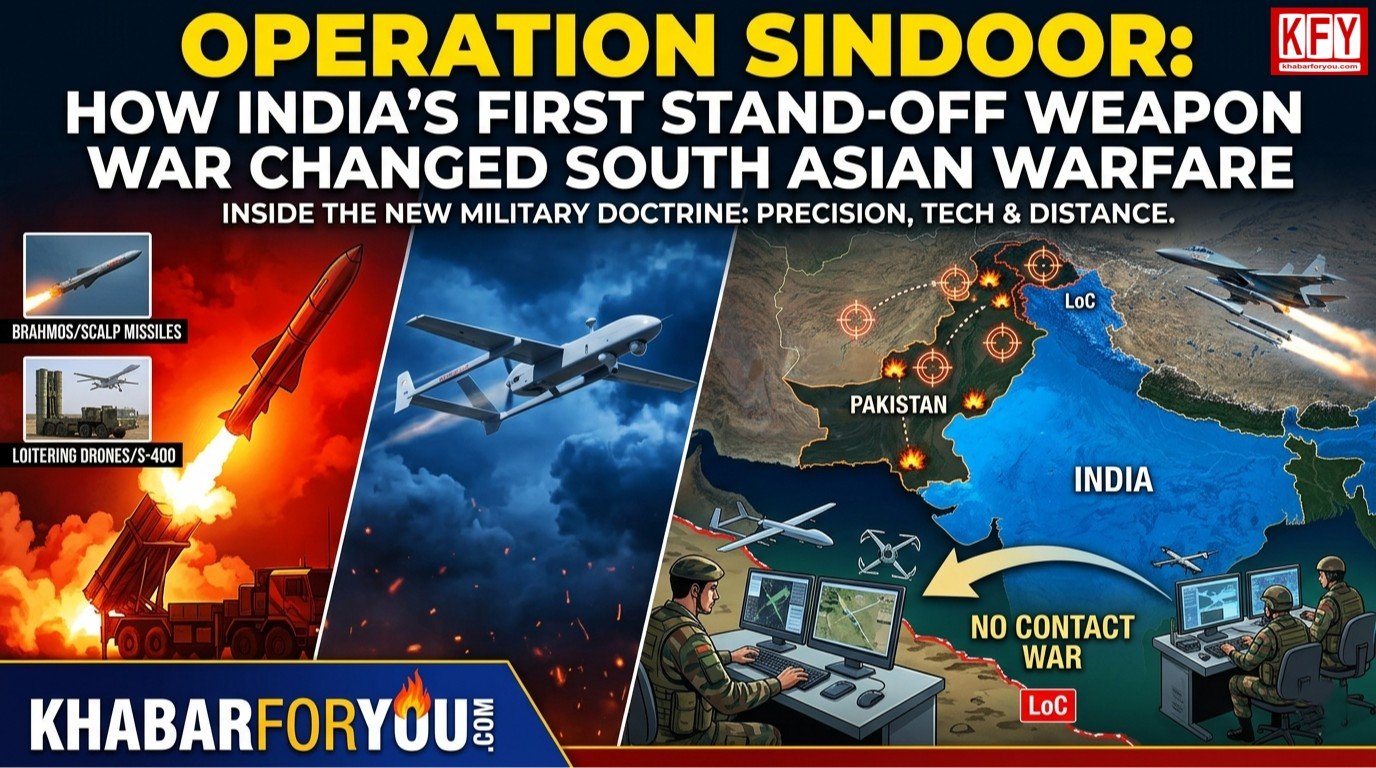
Operation Sindoor: How India’s First Stand-Off Weapon War Changed South Asian Warfare
- Khabar Editor
- 07 May, 2026
- 99630

Email:-infokhabarforyou@gmail.com
Instagram:-@khabar_for_you


In the quiet hours of May 2025, the South Asian strategic landscape shifted irrevocably. While previous escalations like the 2016 Surgical Strikes or the 2019 Balakot airstrikes were defined by "boots on the ground" or "wings over enemy soil," **Operation Sindoor** introduced a clinical, cold, and terrifyingly precise doctrine: the Stand-Off War.
For four days, the Indian military executed a high-intensity offensive against nine major terror hubs deep inside Pakistan and Pakistan-occupied Kashmir (PoK). However, unlike previous conflicts, not a single Indian soldier crossed the Line of Control (LoC), and no Indian pilot flew into Pakistani airspace.
This investigative report deciphers how India leveraged its "First Stand-Off Weapon War" to rewrite the rules of modern engagement.
Read More - Operation Sindhoor at One Year: National Security Triumph or Tactical Gamble? | KhabarForYou
The Arsenal of Distance: Precision over Presence
The hallmark of Operation Sindoor was the surgical use of long-range missiles and loitering munitions. According to high-level defense sources and recent strategic assessments, the Indian Air Force (IAF) and Army deployed a "layered strike" strategy.
At the heart of the strike were India’s premier stand-off assets:
BrahMos & SCALP: These supersonic and subsonic cruise missiles were used to decapitate high-value targets. One BrahMos and one SCALP missile reportedly leveled the Jaish-e-Mohammed (JeM) headquarters in Bahawalpur, deep in the Pakistani heartland.
Rampage & Crystal Maze: These air-to-surface missiles were directed at the Lashkar-e-Taiba (LeT) headquarters in Muridke, near Lahore.
Loitering Munitions: While heavy missiles hit the hinterland, "Kamikaze" drones like the Harpy and Harop were used to suppress enemy air defenses (SEAD). These drones hunted and destroyed Chinese-origin air defense systems in Lahore, Sialkot, and Sargodha.
The result was a psychological "shock and awe" campaign. Pakistan’s military command was forced to move its functional aerial assets to Quetta and Peshawar—fleeing the range of Indian missiles—while its naval fleet sought refuge in Balochistan’s remote ports like Gwadar and Pasni.
The ‘No-Fly Zone’ and the S-400 Factor
Operation Sindoor also validated India’s investment in the S-400 Triumf air defense system. During the 88-hour operation, the combination of S-400 batteries and Meteor air-to-air missiles effectively grounded the Pakistan Air Force (PAF).
Reports indicate that at least six Pakistani fighters and surveillance aircraft were neutralized mid-air. Simultaneously, air-launched BrahMos missiles struck 11 airbases, damaging transport aircraft and fighters on the tarmac before they could scramble.
"The message was clear," says a retired Air Marshal. "We didn't need to engage in dogfights. We simply closed their skies from our side of the border."
The Artillery Revolution: Excalibur at the LoC
While missiles dominated the headlines, the Indian Army’s use of **Excalibur guided 155mm shells** transformed the tactical battle along the LoC.
Historically, artillery fire was about volume—saturating an area with shells. In Operation Sindoor, the Army used GPS-guided Excalibur rounds to "pulverize" specific Pakistani bunkers with pinpoint accuracy. The devastation was so concentrated over a 50-kilometer stretch that Pakistani troops reportedly abandoned forward positions, retreating 10 kilometers behind the LoC to escape the "precision rain."
Counter-Strike Neutralization: The Turkish Drone Failure
One of the most significant takeaways for global military observers was the failure of Pakistan’s counter-offensive. Islamabad attempted to retaliate using Fatah-1 rockets and Turkish-made Bayraktar drones—the same drones that had seen success in the Ukraine and Nagorno-Karabakh conflicts.
However, Indian integrated air defense systems intercepted these threats with near-zero collateral damage. This failure signaled a shift: the era of cheap drone dominance may be meeting its match in sophisticated, multi-layered electronic warfare and kinetic interceptors.
The Strategic Pivot: "No-Contact" is the Future
Post-Operation Sindoor, New Delhi has doubled down on its "No-Contact War" doctrine. The Ministry of Defence has accelerated the procurement of:
1. RVV-BD Missiles: Long-range (160km+) air-to-air missiles from Russia.
2. PULS Rocket Systems: 300km range precision rockets.
3. Next-Gen SAMs: Surface-to-air missiles to create an "impenetrable bubble" over Indian naval carrier groups.
Conclusion: A New Era of Deterrence
Operation Sindoor represents more than just a military victory; it represents a technological divorce from the traditional "attrition warfare" of the 20th century. By using stand-off weapons, India has significantly raised the "cost of provocation" for Pakistan while minimizing the "risk of escalation" that comes with captured pilots or ground casualties.
As an Indian Army official noted during the one-year anniversary: "The era of land battles involving massive troop movements is fading. The future belongs to the side that sees first and strikes from furthest."
© 2023 Khabar For You. All Rights Reserved.
Business, Sports, Lifestyle ,Politics ,Entertainment ,Technology ,National ,World ,Travel ,Editorial and Article में सबसे बड़ी समाचार कहानियों के शीर्ष पर बने रहने के लिए, हमारे subscriber-to-our-newsletter khabarforyou.com पर बॉटम लाइन पर साइन अप करें। |
| यदि आपके या आपके किसी जानने वाले के पास प्रकाशित करने के लिए कोई समाचार है, तो इस हेल्पलाइन पर कॉल करें या व्हाट्सअप करें: 8502024040 |
#KFY #KFYNEWS #KHABARFORYOU #WORLDNEWS
नवीनतम PODCAST सुनें, केवल The FM Yours पर
Click for more trending Khabar
Leave a Reply
Your email address will not be published. Required fields are marked *
Search
Category